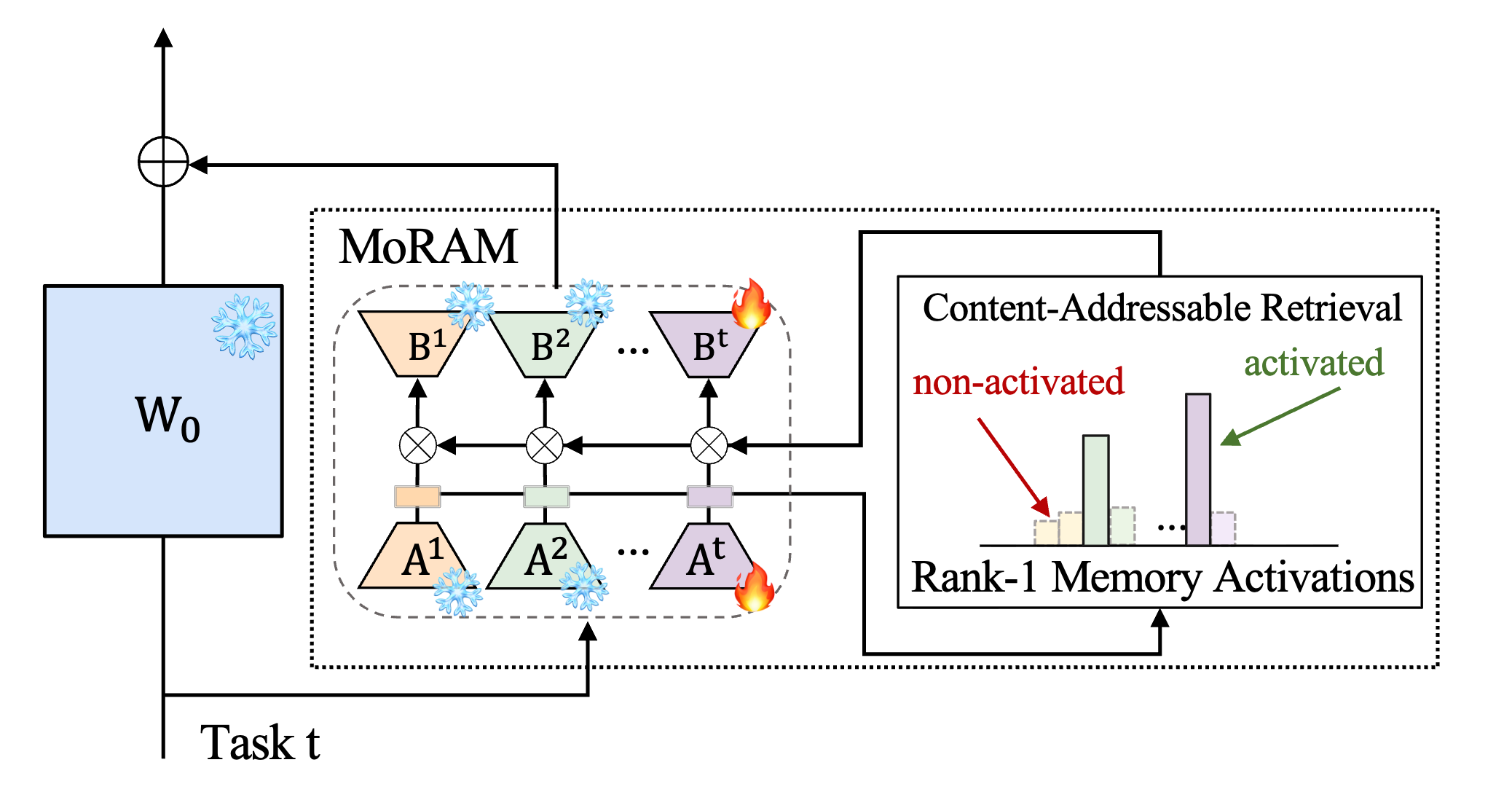
MoRAM grows atomic rank-1 associative memory experts little by little for continual learning on large pre-trained models.
Continual learning (CL) with large pre-trained models is challenged by task interference and catastrophic forgetting. Existing LoRA-based Mixture-of-Experts (MoE) methods mitigate forgetting by adding new task-specific adapters and freezing old ones, but often suffer from redundancy, interference, and ambiguous routing due to coarse-grained experts and routing.
We propose MoRAM (Mixture of Rank-1 Associative Memory). Grounded in the view that weight matrices behave as linear associative memories, MoRAM grows capacity by incrementally adding atomic rank-1 memory experts. Treating rank-1 adapters as key–value pairs removes the need for an explicit MoE router: a self-activation mechanism lets each memory atom score its own relevance via its intrinsic key, turning adaptation into content-addressable retrieval. Experiments on CLIP and LLMs show that MoRAM improves the plasticity–stability trade-off and generalization while mitigating forgetting.
“Little by little, we gave you everything you ever dreamed of …” — Little by little, Oasis.
Parameter-efficient fine-tuning with LoRA (Fig. 1(a)) injects adaptation as a single dense low-rank update on top of frozen pre-trained weights. Under a continual stream of tasks, editing that shared subspace for the new task perturbs the representation geometry relied on by earlier tasks, so plasticity and stability trade off sharply.
MoE-LoRA (Fig. 1(b)) reduces forgetting by freezing older adapters and routing each input to a sparse set of task-specific experts, but each expert is still a coarse rank-\(r\) LoRA treated as an indivisible unit. That encourages interference within experts, redundant capacity, and an external router that must discriminate overlapping experts — routing ambiguity and retrieval collapse worsen as experts accumulate.
MoRAM (Fig. 1(c)) learns atomic rank-1 memory experts incrementally while freezing ranks from past tasks, and combines all atoms with a sparse, input-dependent mixture whose scores come from each atom’s intrinsic key — fine-tuning of pre-trained weights becomes fine-grained rank-1 memory atom retrieval instead of coarse-grained routing by an auxiliary module.
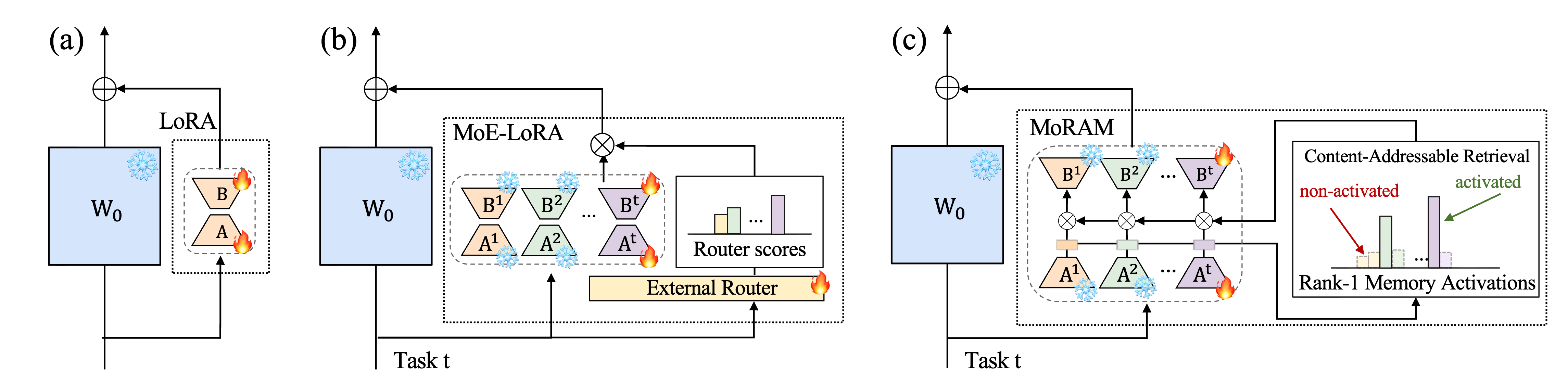
Figure 1. Conceptual illustration of continual learning with (a) LoRA, (b) MoE-LoRA, and (c) MoRAM (ours).
Each new task freezes all earlier rank-1 atoms and adds \(r\) new ones. A sparse self-activated mixture over the full bank sets input-dependent weights so only a few ranks activate at once. Figure 2 sketches growth from task \(t\) to \(t+1\): (a,c) conceptually, (b,d) the mixture computation. §3.2–§3.3 fill in the math.
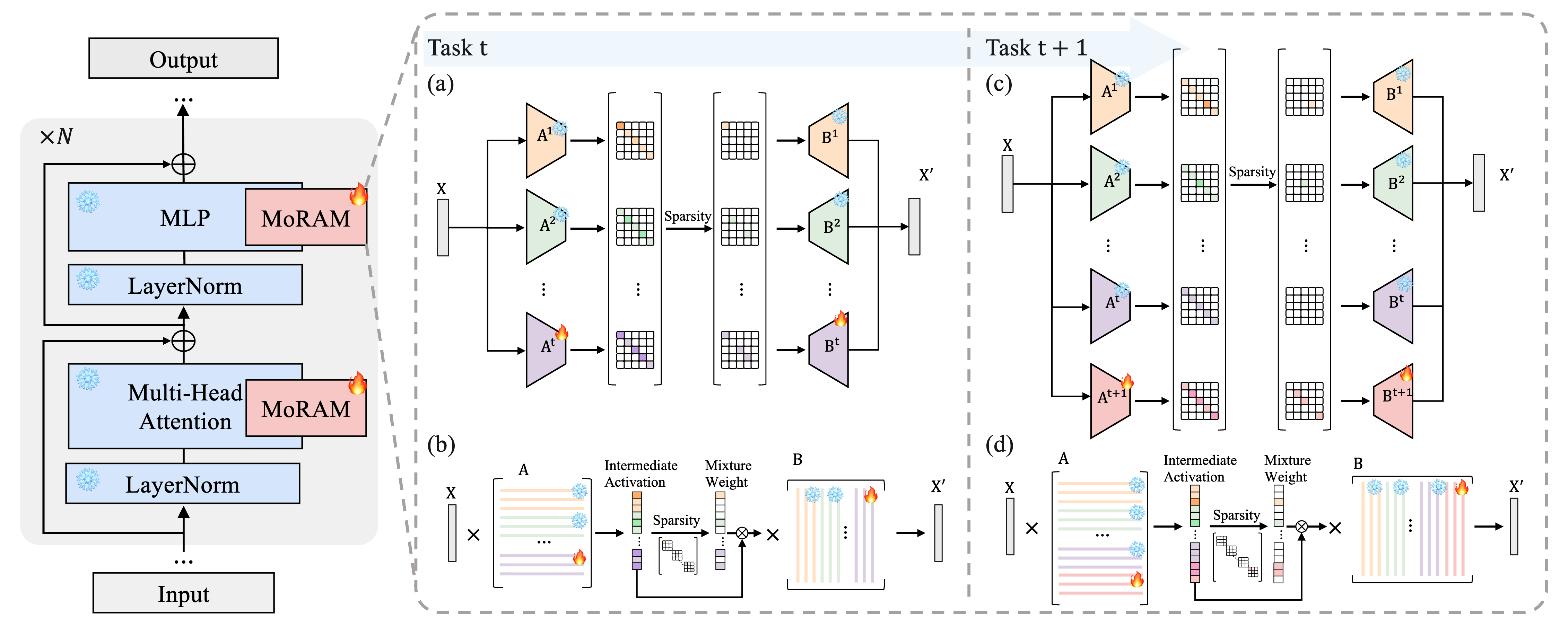
Figure 2. Freeze past ranks, add \(r\) new ranks, sparse mixture over all atoms. (a,c) overview; (b,d) tasks \(t\) and \(t+1\).
To mitigate the coarse granularity and routing ambiguity of dense rank-\(r\) updates, the paper reframes LoRA not as monolithic blocks but as a linear associative memory over the weight matrix.
Definition 1 (informal). A matrix \(\mathbf{W}\in\mathbb{R}^{d_{\text{out}}\times d_{\text{in}}}\) of rank \(m\) is viewed as \(m\) atomic key–value pairs \(\{(\mathbf{k}_{i},\mathbf{v}_{i})\}_{i=1}^{m}\) with \(\mathbf{k}_{i}\in\mathbb{R}^{d_{\text{in}}}\), \(\mathbf{v}_{i}\in\mathbb{R}^{d_{\text{out}}}\), and \(\mathbf{W}\approx\sum_{i=1}^{m}\mathbf{v}_{i}\mathbf{k}_{i}^{\top}\). For a hidden state \(\mathbf{x}\), the product \(\mathbf{W}\mathbf{x}\) acts like a content-addressable read: each inner product \(\mathbf{k}_{i}^{\top}\mathbf{x}\) scores relevance to slot \(i\) and gates the retrieved value \(\mathbf{v}_{i}\).
Remark. Unlike self-attention—where keys and values are dynamic functions of the input—here \(\mathbf{k}_{i}\) and \(\mathbf{v}_{i}\) are static parameters of the matrix, encoding patterns acquired during pre-training.
Fine-grained rank-1 memory augmentation. The low-rank update \(\Delta\mathbf{W}\) is not one rank-\(r\) slab but a sum of \(r\) rank-1 key–value pairs: row \(\mathbf{A}_{i,:}\) acts as the Key (relevance to the input) and column \(\mathbf{B}_{:,i}\) as the Value (stored correction). Adaptation becomes memory expansion—a flexible set of atoms rather than a single rigid adapter.
Standard LoRA (and MoE-LoRA at the adapter level) still densely mixes rank-1 components, which encourages interference on mismatched inputs and routing collapse by ignoring the natural role of \(\mathbf{A}\) as content-based retrieval keys in favor of indiscriminate activation or extra routers.
MoRAM formulation. Adaptation parameters are a growing set of atoms \(\mathcal{M}_{t}=\{(\mathbf{B}_{:,i},\mathbf{A}_{i,:})\}_{i=1}^{r_{t}}\). For task \(t\), the effective update is a sparse, input-dependent mixture with weights \(\mathrm{w}_{i}\in\mathbb{R}\) (retrieval confidence for atom \(i\)):
This lets the model freeze old atoms for stability while adding new ones for plasticity, or combine several memories when concepts overlap—without an auxiliary router module.
Mixing weights come from each rank-1 adapter’s own key \(\mathbf{A}_{i,:}\), not from a separate MoE router over \((\mathbf{A}_{i,:},\mathbf{B}_{:,i})\) pairs—routing is content-addressable retrieval over static memory keys, which avoids extra router parameters and the forgetting they can introduce.
Self-activated relevance scoring. For hidden state \(\mathbf{x}\in\mathbb{R}^{d_{\text{in}}}\) and \(r_{t}\) accumulated atoms after task \(t\), the raw score \(s_{i}\) for atom \(i\) is the key response \(\mathbf{A}_{i,:}\mathbf{x}\), \(\ell_{2}\)-normalized across all atoms:
The numerator is alignment with key \(i\); the denominator stabilizes scale across the memory bank. The paper finds this intrinsic scoring competitive with external routers (their Table 4).
While Eq. (5) measures relevance, naive dense activation leads to low specialization and induces interference and computational overhead; MoRAM therefore uses sparse routing to sharpen the mixture.
Sparse rank selection. To limit interference and cost, we enforce sparsity via top-\(k\) masking: only the \(k\) largest scores stay active; others are masked to \(-\infty\) before softmax so at most \(k\) of the \(r_{t}\) atoms receive gradient.
Sharpness enhancement. To further encourage rank specialization and concentrate the update on the most relevant ranks, mixture weights use temperature-scaled softmax on the masked scores with \(\tau_{\text{MoRAM}}\); lower \(\tau_{\text{MoRAM}}\) sharpens which experts activate in the forward pass and routes gradients more selectively in the backward pass.
Threshold-based expert selection. At inference, a cutoff \(\delta\) on normalized scores filters weak experts among the top-\(k\) set, reducing compute and noise:
This yields a highly sparse, input-dependent set comprising only the most significant memory experts.
X-TAIL is a cross-domain, task-incremental protocol for CLIP-style models: a sequence of image-classification domains. We report Transfer (future domains before training), Average (mean over stages and domains), and Last (all seen domains after the full run)
TRACE benchmarks continual learning in LLMs with eight mixed tasks (e.g. reasoning, summarization, code). We report Overall Performance (OP) after the final task and Backward Transfer (BWT) for forgetting; higher OP and lower BWT are better.
Comparisons on X-TAIL for each domain in terms of Transfer, Average, and Last accuracy (%). Section labels and the rightmost Average column follow the paper. MoRAM rows are highlighted.
| Method | Aircraft | Caltech | DTD | EuroSAT | Flowers | Food | MNIST | OxPet | Cars | SUN397 | Average |
|---|---|---|---|---|---|---|---|---|---|---|---|
| CLIP | |||||||||||
| Zero-shot | 23.5 | 76.8 | 37.3 | 36.7 | 63.6 | 84.0 | 46.7 | 86.7 | 66.1 | 63.7 | 58.5 |
| Fine-tune | 39.6 | 84.7 | 70.0 | 94.7 | 97.0 | 85.8 | 97.6 | 93.4 | 81.0 | 74.7 | 81.9 |
| Transfer | |||||||||||
| CLIP zero-shot | — | 76.8 | 37.3 | 36.7 | 63.6 | 84.0 | 46.7 | 86.7 | 66.1 | 63.7 | 62.4 |
| LwF | — | 66.6 | 26.9 | 19.5 | 51.0 | 78.4 | 26.6 | 68.9 | 35.5 | 56.1 | 47.7 |
| WiSE-FT | — | 70.1 | 31.9 | 25.3 | 56.3 | 79.8 | 29.9 | 74.9 | 45.6 | 56.8 | 52.3 |
| iCaRL | — | 71.7 | 35.0 | 43.0 | 63.4 | 86.9 | 43.9 | 87.8 | 63.7 | 60.0 | 61.7 |
| ZSCL | — | 73.3 | 32.6 | 36.8 | 62.1 | 83.8 | 42.1 | 83.6 | 56.5 | 60.2 | 59.0 |
| MoE-Adapter | — | 71.0 | 34.9 | 19.2 | 63.0 | 86.6 | 20.0 | 87.2 | 63.7 | 58.6 | 56.0 |
| RAIL-Primal | — | 76.8 | 37.3 | 36.7 | 63.6 | 84.0 | 46.7 | 86.7 | 66.1 | 63.7 | 62.4 |
| CoDyRA | — | 74.3 | 36.8 | 44.2 | 69.9 | 83.5 | 42.8 | 88.9 | 64.6 | 63.4 | 63.2 |
| MoRAM | — | 74.5 | 38.1 | 46.9 | 65.3 | 82.9 | 45.8 | 88.2 | 65.1 | 62.9 | 63.3 |
| Average | |||||||||||
| LwF | 24.7 | 79.7 | 38.3 | 36.9 | 63.9 | 81.0 | 36.5 | 71.9 | 42.7 | 56.7 | 53.2 |
| WiSE-FT | 27.1 | 76.5 | 40.9 | 31.3 | 68.7 | 81.6 | 31.4 | 74.7 | 51.7 | 58.4 | 54.2 |
| iCaRL | 25.4 | 72.1 | 37.5 | 51.6 | 65.1 | 87.1 | 59.1 | 88.0 | 63.7 | 60.1 | 61.0 |
| ZSCL | 36.0 | 75.0 | 40.7 | 40.5 | 71.0 | 85.3 | 46.3 | 83.3 | 60.7 | 61.5 | 60.0 |
| MoE-Adapter | 43.6 | 77.9 | 52.1 | 34.7 | 75.9 | 86.3 | 45.2 | 87.4 | 66.6 | 60.2 | 63.0 |
| RAIL-Primal | 42.4 | 89.8 | 55.7 | 68.5 | 84.0 | 83.3 | 65.3 | 85.8 | 67.9 | 64.5 | 70.7 |
| CoDyRA | 41.4 | 81.0 | 58.7 | 77.8 | 83.4 | 84.6 | 64.5 | 90.4 | 67.2 | 64.4 | 71.3 |
| MoRAM | 44.1 | 81.6 | 64.6 | 79.6 | 83.9 | 84.4 | 66.5 | 89.7 | 68.4 | 64.1 | 72.7 |
| Last | |||||||||||
| LwF | 25.5 | 72.1 | 38.9 | 55.4 | 65.5 | 87.3 | 81.9 | 88.6 | 63.6 | 61.5 | 64.0 |
| WiSE-FT | 21.8 | 76.8 | 42.9 | 20.8 | 77.5 | 84.9 | 30.7 | 76.6 | 75.8 | 72.5 | 58.0 |
| iCaRL | 25.5 | 72.1 | 38.9 | 55.4 | 65.5 | 87.3 | 81.9 | 88.6 | 63.6 | 61.5 | 64.0 |
| ZSCL | 33.1 | 75.3 | 43.5 | 35.2 | 74.6 | 87.4 | 50.4 | 84.2 | 77.3 | 73.4 | 63.4 |
| MoE-Adapter | 43.2 | 78.7 | 57.6 | 32.8 | 79.4 | 86.0 | 86.7 | 87.8 | 78.2 | 74.2 | 70.5 |
| RAIL-Primal | 41.7 | 94.0 | 66.0 | 86.4 | 97.2 | 82.4 | 93.1 | 83.6 | 75.0 | 71.3 | 79.1 |
| CoDyRA | 37.7 | 81.5 | 65.1 | 89.9 | 91.4 | 85.5 | 96.8 | 93.3 | 77.3 | 73.5 | 79.2 |
| MoRAM | 37.7 | 81.5 | 70.7 | 92.4 | 95.0 | 86.0 | 97.6 | 92.6 | 81.0 | 74.7 | 80.9 |
Comparison on the TRACE benchmark: Overall Performance (OP, higher is better) and Backward Transfer (BWT, lower is better). Values are mean ± standard deviation over three runs. The MoRAM column is highlighted.
| FIX(ICL) | SeqLoRA | OGD | GEM | EWC | L2P | DualPrompt | HiDeLoRA | O-LoRA | TreeLoRA | MoRAM | |
|---|---|---|---|---|---|---|---|---|---|---|---|
| meta-llama / LLaMA-2-7B-Chat | |||||||||||
| OP | 38.94 ± 0.3 | 34.3 ± 1.2 | 42.09 ± 1.6 | 40.08 ± 1.6 | 42.36 ± 1.2 | 36.23 ± 0.8 | 37.69 ± 1.2 | 41.60 ± 0.8 | 42.78 ± 0.8 | 43.52 ± 1.0 | 44.54 ± 0.9 |
| BWT | – | 18.5 ± 0.8 | 8.06 ± 1.2 | 6.77 ± 1.2 | 5.97 ± 0.8 | 8.25 ± 0.8 | 8.03 ± 0.8 | 7.12 ± 0.4 | 7.16 ± 0.4 | 3.46 ± 0.4 | 1.37 ± 0.3 |
| google / Gemma-2B-it | |||||||||||
| OP | 32.3 ± 0.2 | 31.89 ± 0.8 | 32.85 ± 1.4 | 26.48 ± 1.5 | 28.35 ± 1.6 | 31.14 ± 1.2 | 32.42 ± 1.0 | 33.25 ± 0.9 | 33.73 ± 0.8 | 33.41 ± 0.9 | 36.27 ± 0.7 |
| BWT | – | 15.28 ± 0.4 | 12.27 ± 0.9 | 18.25 ± 0.9 | 16.96 ± 1.2 | 15.77 ± 0.7 | 14.25 ± 0.5 | 13.66 ± 0.5 | 12.36 ± 0.4 | 8.50 ± 0.5 | 2.74 ± 0.4 |
| meta-llama / LLaMA-3-1B-Instruct | |||||||||||
| OP | 31.16 ± 0.4 | 29.73 ± 1.6 | 30.12 ± 2.0 | 32.19 ± 2.0 | 31.96 ± 1.6 | 29.38 ± 1.2 | 30.76 ± 1.2 | 33.73 ± 1.2 | 32.94 ± 0.8 | 36.14 ± 0.7 | 37.77 ± 0.8 |
| BWT | – | 17.03 ± 1.2 | 15.2 ± 1.6 | 10.74 ± 1.6 | 11.62 ± 1.2 | 13.57 ± 0.8 | 11.34 ± 0.8 | 12.36 ± 0.8 | 12.89 ± 1.2 | 7.36 ± 0.8 | 3.12 ± 0.8 |
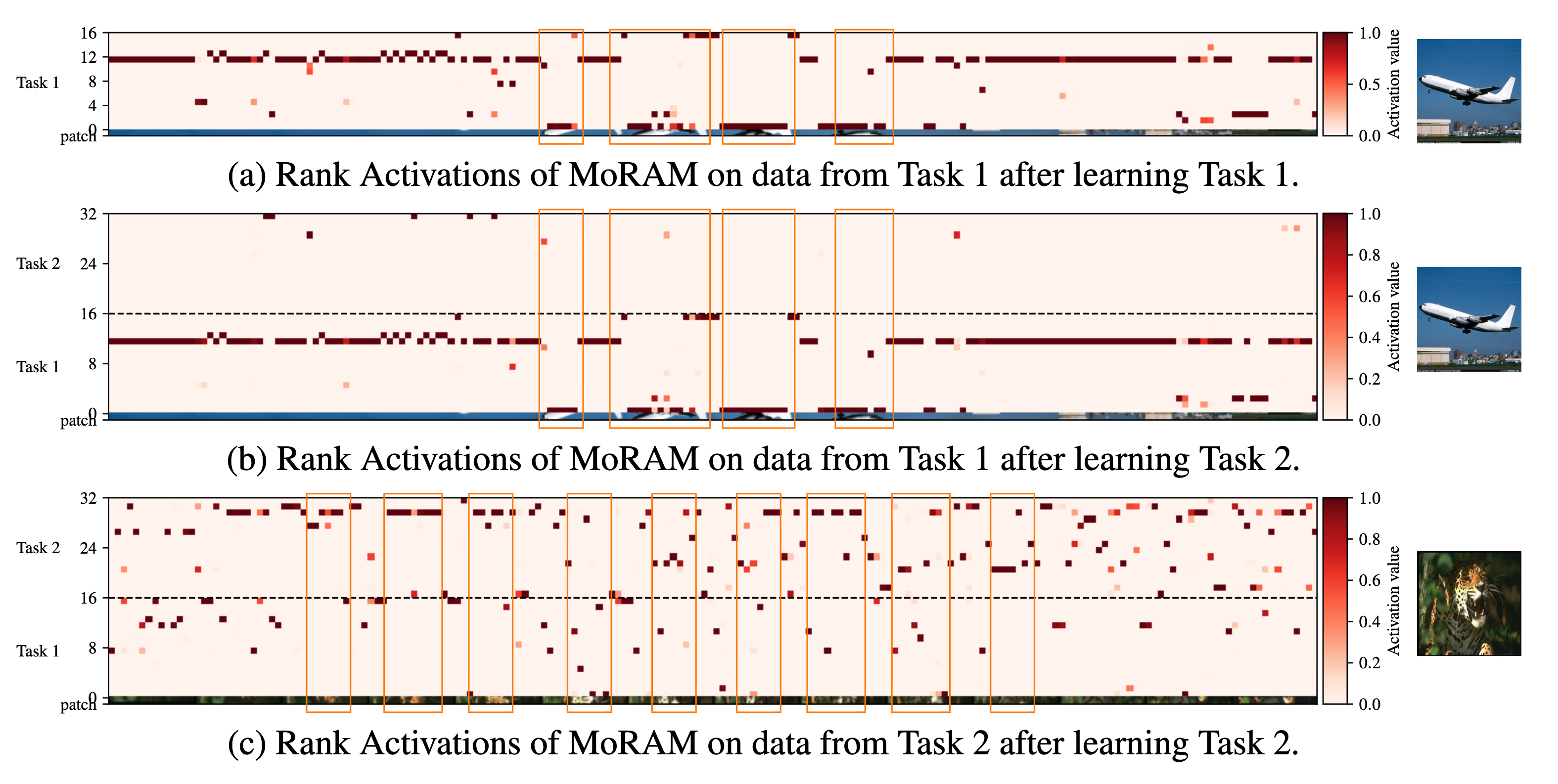
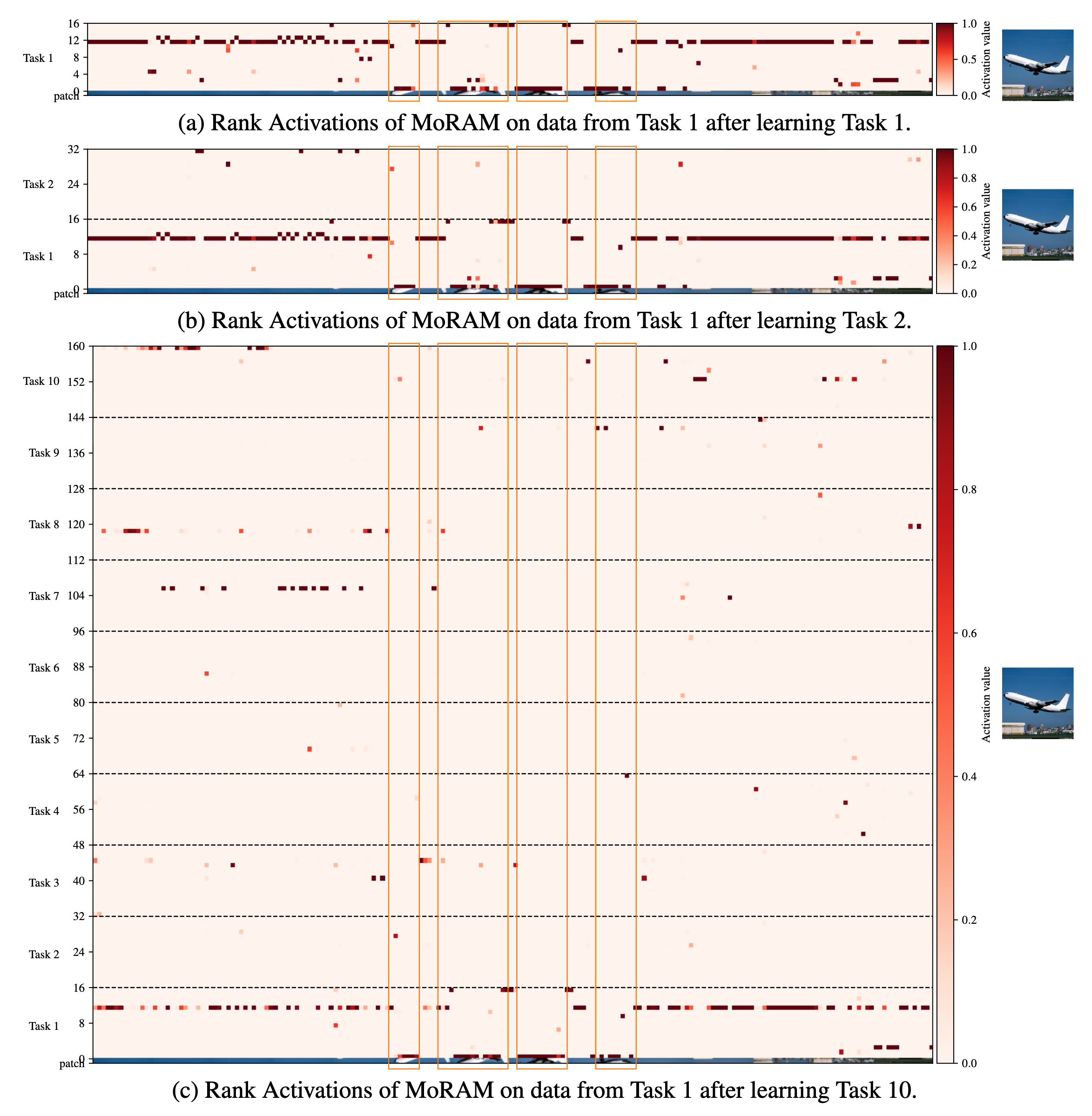
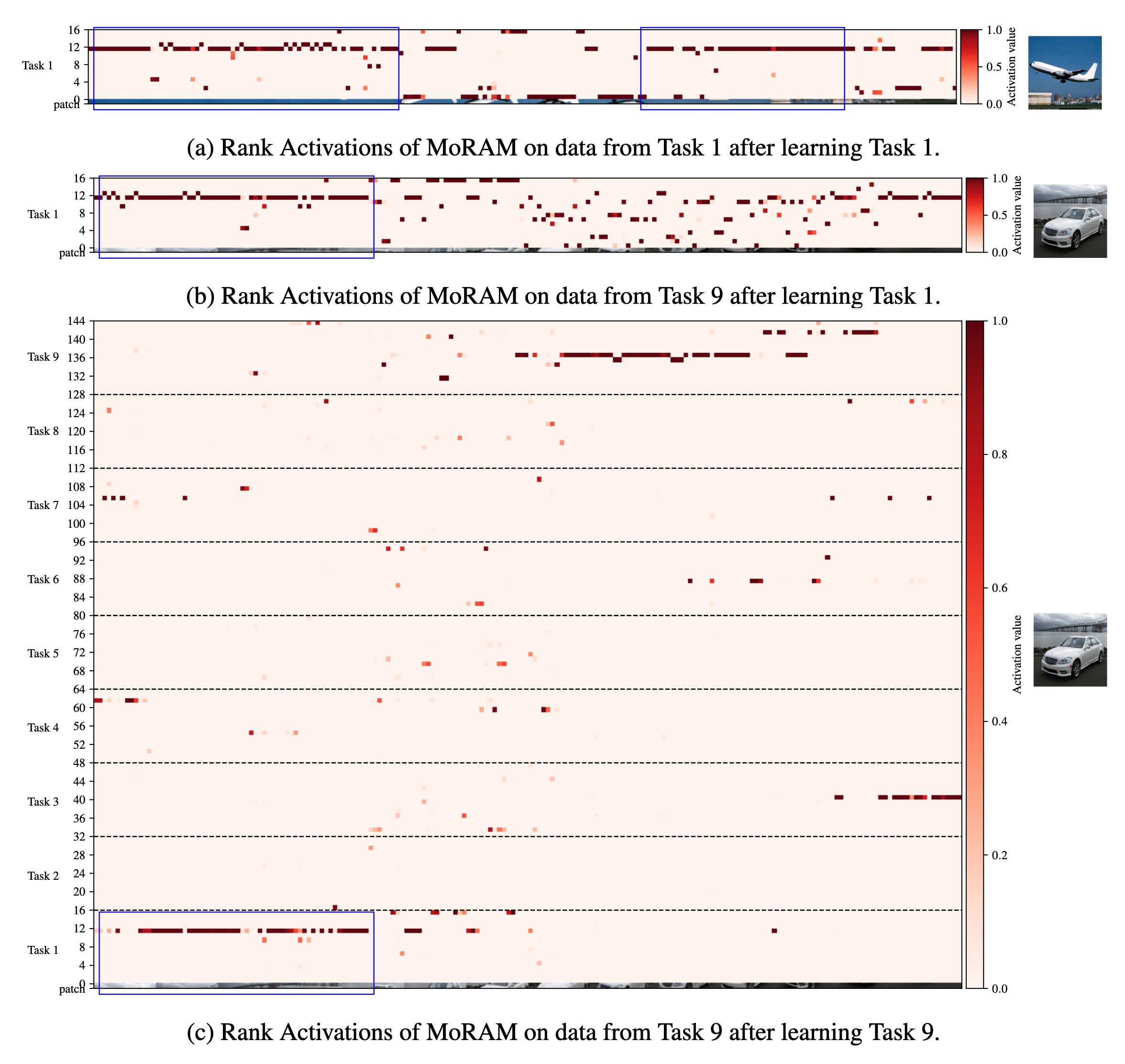
Because MoRAM routes through per-atom mixture weights, we can read off each rank-1 atom’s contribution as a rank activation map: a heatmap whose rows are rank indices (grouped by task, separated by dashed lines) and columns are image patches, with colour intensity proportional to activation value. Maps below are extracted from the \(K\) projection in CLIP’s image-encoder attention (layer 8) during continual fine-tuning on X-TAIL. Coloured boxes highlight semantically informative patch columns. Together the three figures illustrate atom specialization, forgetting mitigation, and knowledge reuse. For full analysis and protocol, see §4.2 and Appendix A.12 in the paper.
(a) Task 1 (Aircraft) input evaluated after learning Task 1 only — 16 ranks available. A handful of ranks (e.g. rank 12) fire strongly on specific patches while others stay near zero, showing clear specialization. (b) The same Task 1 input re-evaluated after Task 2 is added (32 ranks total). Task 1 ranks (1–16) retain virtually the same pattern; the newly added Task 2 ranks (17–32) remain mostly silent — evidence that new capacity does not disturb earlier atoms. (c) A Task 2 input evaluated after learning Task 2. Task 2 ranks now show strong, distinct activations, while some Task 1 ranks also fire where visual patterns overlap, indicating early knowledge reuse. Orange boxes highlight patch columns of interest across panels.
The same Task 1 (Aircraft) input is tracked as the model grows from 16 ranks to 160 ranks over the full 10-task X-TAIL sequence. (a) After Task 1 (16 ranks). (b) After Task 2 (32 ranks). (c) After Task 10 (160 ranks). Despite the memory bank expanding by 10×, Task 1 ranks retain essentially the same activation pattern — strong, consistent firing on the same patch columns across all three snapshots. Ranks from Tasks 2–10 remain largely inactive on Task 1 data, confirming that the freeze-and-expand design prevents cross-task interference even as capacity grows.
Blue boxes trace shared visual structure across domains. (a) Task 1 (Aircraft) data after learning Task 1 — blue boxes mark the patch groups where Task 1 ranks respond most. (b) Later-task data (Cars) evaluated with only Task 1 atoms — Task 1 ranks still fire on patches with comparable spatial structure (e.g. object body, background). (c) Task 9 (Cars) data after learning nine tasks (144 ranks). Task 1 ranks (bottom rows, blue box) still activate on patches that share visual structure with Aircraft, while Task 9-specific ranks handle novel object details. This decomposition — reused atoms for shared patterns, fresh atoms for new concepts — emerges naturally from the self-activation mechanism without any explicit reuse objective.
@article{lu2025little,
  title   = {Little By Little: Continual Learning via Incremental Mixture
             of Rank-1 Associative Memory Experts},
  author  = {Lu, Haodong and Zhao, Chongyang and Xue, Jason and Yao, Lina
             and Moore, Kristen and Gong, Dong},
  journal = {arXiv preprint arXiv:2506.21035},
  year    = {2025},
}